How to Grow Nepenthes

No terrariums.  No myths.  No nonsense.
Practical advice based on decades of growing and propagating carnivorous plants.

About This Guide

This guide focuses on commonly available Nepenthes species and hybrids grown as houseplants. Some rare and specialty Nepenthes have narrower environmental requirements and may perform best with more carefully controlled temperatures, humidity, lighting, and airflow. These narrower requirements are not typical of the commonly available Nepenthes covered in this guide.

Nepenthes Care at a Glance

Growing Requirement Our Recommendation
Light Several hours of unobstructed, direct sunlight with bright filtered light during the rest of the day. Avoid full shade.
Artificial Light Use LED shop lights producing approximately 2,500 lumens or more, starting about 12 inches above the plant. Use a 14-hour daylight cycle.
Temperature Days in the 70s°F (22–26°C) with nights in the 60s°F (16–20°C). Avoid frost and prolonged temperatures in the 40s°F.
Humidity Most commonly grown Nepenthes can acclimate to normal household humidity. Higher humidity may produce somewhat larger pitchers, but it is not a driving force for pitcher production in the way that sunlight and temperature are.
Water Water thoroughly and allow excess water to drain. Nepenthes can tolerate water up to approximately 200 ppm. Avoid standing water.
Soil Use 1 part dried sphagnum moss to 1 part perlite. Do not use conventional potting soil or compost.

Grower's Key Point

The most important factor for pitcher production is adequate light. If your Nepenthes is growing leaves but not producing pitchers, insufficient light is one of the first things to investigate.

Want a printable quick reference?
Download our one-page Nepenthes Care Guide (PDF)


Where Do Nepenthes Grow Naturally?

The genus Nepenthes occupies a vast natural range, spanning from Madagascar and the Seychelles, India and Indochina, throughout the innumerable islands of Southeast Asia, and into the northeastern cape of Australia. Such a gigantic distribution has resulted in an extraordinary diversity of forms among the 170+ species, from squat, ground-hugging detritivores to tall, arcing vines; some with tiny speckled traps like miniature wine glasses, others grown beastly with sharp, hook-lined gullets that drown rodents, and some remarkable species bearing pitchers that serve as roosts for bats.

Can Nepenthes Be Grown Like a Houseplant?

Many common varieties of Nepenthes originate where common houseplants originate, so they will grow spectacularly on sunny windowsills. Unobstructed windowsills facing south, east, or west are appropriate, the main concern being ample sunlight.

You may be able to grow Nepenthes outside if you live in a subtropical climate, like San Diego or Miami. Many can take brief overnight chills down to 40°F (4°C), but the daytime temperature should be in the mid-70s. Always avoid frost.

How Much Light Do Nepenthes Need?

Provide partial sunlight, several hours of unobstructed, direct sun with bright filtered light during the rest of the day. Avoid full shade.

Sunlight is the key element in getting your plant to grow pitchers. The energy provided by photosynthesis is what grows pitchers, and sunlight is essential for pitcher production and good color. With proper sunlight, many Nepenthes can be grown as regular houseplants.


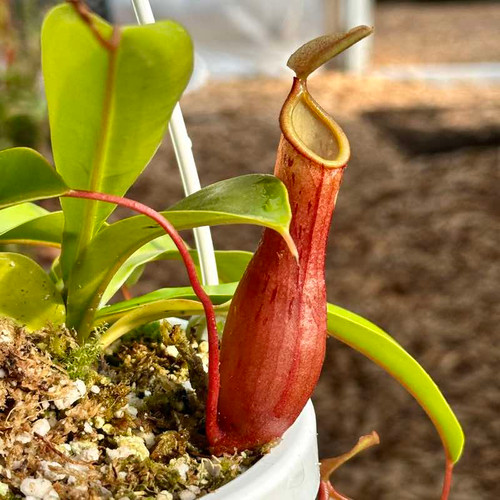
The photos below are from our customers.
They grow their Nepenthes like houseplants.

What LED Lights Should I Use to Grow Nepenthes?

If a sunny window is not available, use LED shop lights with an output of at least 2,500 lumens. We prefer white LED shop lights rather than lights with red and blue diodes. In our experience, the red and blue lights can cause eye strain, and we haven't found them necessary for healthy plant growth. Start with the lights approximately 12 inches above the plant. Monitor your plant and adjust the height of the light source if you are not satisfied with its growth. Use an electrical timer to maintain a 14-hour daylight cycle.

Want to learn more about our setup?
See LED Lights for Tropical Plants .

What Temperatures Do Nepenthes Need?

Chances are if you’re comfortable in jeans and a t-shirt, your Nepenthes are comfortable, so it’s not necessary to fret about the temperature. They grow well when the day temperature is in the 70s (22°-26°C) with a nighttime drop into the 60s (16°-20°C), common temperatures many houseplants thrive in. Avoid frost and prolonged exposures of temperatures in the 40s (6°-10°C).

How Much Humidity Do Nepenthes Need?

For most commonly grown Nepenthes, humidity is far less important than adequate light and suitable temperatures. Established plants can acclimate to normal household humidity and produce healthy pitchers without a terrarium, humidifier, or humidity dome.

Humidity is not irrelevant. When the plant’s other growing requirements are met, higher humidity may produce somewhat larger leaves and pitchers. However, high humidity will not compensate for inadequate light, unsuitable temperatures, poor watering practices, or unhealthy roots, nor does it drive pitcher production the way sunlight and temperature do.

Why does our advice differ from what others say about Nepenthes and humidity?

We don't just accept common assumptions about plant care. We put them to the test. Watch our videos about our experience growing Nepenthes in normal household humidity and find out what the actual role humidity has on Nepenthes:
Q/A #160 - Do Nepenthes Need High Humidity? The Humidity Myth, Part 1
Q/A #161 - Do Nepenthes Need a Humidity Dome? The Humidity Myth, Part 2

How Do I Water a Nepenthes?

Unlike many other carnivorous plants, most commonly grown Nepenthes are relatively tolerant of water containing higher mineral levels. They can generally tolerate water up to approximately 200 ppm when watered thoroughly from above and allowed to drain completely. For the simplest and safest recommendation, use rainwater, distilled water, reverse-osmosis water, or tap water containing 50 ppm or less of dissolved minerals.

Always water thoroughly until the entire potting mix is saturated, and allow the excess water to drain completely. Do not leave the pot standing in water. Constantly saturated conditions reduce aeration around the roots and can lead to root problems. Water again when the upper layer of the potting mix begins to lose moisture, but before it dries completely.

What Soil Do Nepenthes Need?

Use a mix of 1 part dried sphagnum moss and 1 part perlite. Moisten the ingredients thoroughly before potting up your plant. Avoid using potting soil and compost, as their nutrient and mineral ingredients can kill carnivorous plants.

Don't want to mix your own?
Our tropical pitcher plant mix is excellent for Nepenthes, Heliamphora, and Brocchinia.

When Should I Repot My Nepenthes?

Nepenthes don't need to be repotted on a fixed schedule. Repot when the plant looks too large for its container or when the potting mixture has begun to break down, become compacted, or no longer drains well.

Choose a pot with drainage holes that is appropriately sized for the plant. Avoid using an excessively large container, which can hold more water than the plant needs. Repot using the same mixture recommended above: 1 part dried sphagnum moss to 1 part perlite.

Nepenthes have relatively fine roots, so handle the root system gently and avoid unnecessarily removing potting material that is firmly attached to healthy roots. Position the plant at approximately the same depth at which it was previously growing, water thoroughly, and allow excess water to drain.

Some temporary slowing of growth after repotting is normal. Return the plant to its usual growing conditions and avoid making additional major changes to its environment while it becomes established in the new pot.

Troubleshooting Common Nepenthes Problems

Nepenthes Isn't Producing Pitchers

Learn why healthy-looking plants sometimes stop making pitchers and what to check first.
Q/A #162: Troubleshooting a Pitcherless Nepenthes: 6 Things to Check
Q/A #156: Revitalizing a Pitcherless Nepenthes
Q/A #119: Large Nepenthes Stopped Producing Pitchers
Q/A #68: No Pitchers on Nepenthes Despite Misting

Nepenthes Leaves Are Turning Yellow

Learn how to distinguish normal aging from environmental or root problems.
Q/A #157: Rescuing a Nepenthes with Yellow Leaves

Nepenthes Pitchers Are Deformed

Learn what can cause new pitchers to develop abnormally and how to identify an unexpected environmental culprit.
Q/A #158: An Unexpected Cause of Deformed Nepenthes Pitchers

Our Growing Experience

Every recommendation in this guide reflects the methods we've found to be most reliable through decades of growing and propagating carnivorous plants commercially. While every growing environment is unique, these techniques have consistently produced healthy plants in our nursery and helped thousands of customers grow with confidence. We regularly review and update our guides as we continue to refine our growing practices and receive feedback from our customers.

Want to learn more about Nepenthes?

• For seasonal growing reminders, visit our Monthly Care Guide.
• If you are new to carnivorous plants or want a more detailed explanation of how sunlight, water, soil, temperature, and humidity affect plant growth, see The Ultimate Carnivorous Plant Guide for Beginners.
• Still have a specific growing problem after reviewing this guide and the troubleshooting links above? Ask the Growers.


Ready to Grow a Nepenthes?

Our Nepenthes are shipped potted and backed by our 30-Day Guarantee.
Inventory changes monthly and seasonally.
Click here to browse our current Nepenthes selection.

Your cart is empty

Most Popular