The Humidity Myth, Part 1: Your Nepenthes Doesn't Need a Rainforest
- November 15, 2025
Jacob here with Sarracenia Northwest. In this video, I’m going to talk about humidity and Nepenthes, and what really drives pitcher growth on these plants. This is a very complex topic, and a lot of Nepenthes growers have different views. But I’m going to discuss humidity within the context of a question we got earlier this year. Each section of this video is timestamped, so you can skip to appropriate sections and rewatch them if necessary. In March, a grower wrote to us:
“I recently purchased my new Nepenthes sanguinea at a spring festival over the weekend. As I was reading the care sheet, I saw that moderate humidity is a huge factor in order for tropical pitchers to grow their pitchers properly. Thankfully my home town in Indiana gets pretty hot and humid in the summer. But as of now I have it under a humidity dome I have because I can keep that environment quite humid for a pitcher. Would you say this a good temporary solution until summer arrives?” (Submitted in March 2025.)
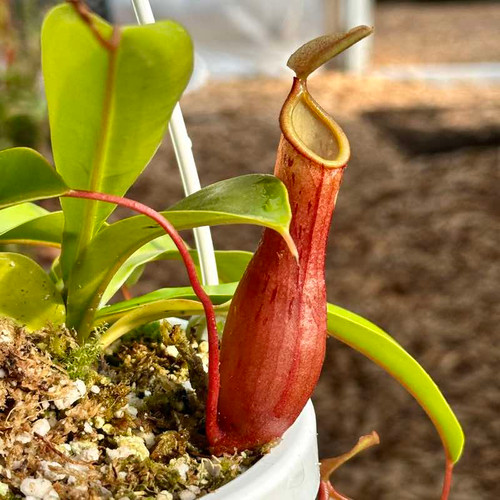
The grower sent a couple of photos of her plant. It looks ok. It has a single pitcher, and the plant looks decent enough. She has another photo of the humidity dome. In her hometown in Indiana, summer can be hot and humid. Since it was spring when she wrote to us, she wanted to know if the humidity dome was a good temporary solution until summer arrived.
First off, her question is a bit of a loaded. It doesn’t have a simple yes or no answer because it’s based on the premise that moderate humidity, or humidity in general, is a huge factor for Nepenthes. Frankly, I don’t buy into that concept, that humidity is a driving factor for pitcher growth. In our experience over the past three decades, the vast majority of Nepenthes available to the average grower can be grown like regular houseplants. Nepenthes sanguinea, is no exception. I used to grow this species in a west-facing window in my home until it got too big for that space. I’ve also grown Nepenthes truncata, albomarginata, and various hybrids in my living room, all without the aid of a humidifier or grow tent.
When we talk about humidity, we’re referring to water vapor in the air, which is expressed as a percentage, such as 40%, 50%, and such. Air can hold only a certain amount of water vapor. How much it holds depends on the temperature. As the temperature goes up, air can hold more water. As the temperature goes down, air holds less water.
So, at cold temperatures, air can reach its maximum capacity, or 100%, fairly quickly. At warm temperatures, air can hold more water vapor, so it takes more water to reach 100% capacity. So, even though you might have 100% humidity in both warm air and in cold air, the actual amount of water vapor in the air is different. That’s why when we refer to humidity, we actually mean relative humidity. We’re looking at the percentage of water vapor relative to the total amount the air can hold at that temperature, regardless of the actual amount of water vapor.
Let’s take a look at relative humidity from a different perspective. Imagine this cup represents the amount of water vapor air can hold at 59°F, and the amount of water vapor in the air is at 75% of air’s maximum capacity.
Now, imagine that the temperature increases to 88°F, as represented by this larger cup. As temperature increases, the amount of water the air can hold also increases. Now, what if we have the same amount of water vapor at this higher temperature as we do at the cooler temperature? The relative humidity percentage goes down. In this case, the percentage is now 30% to what it can actually hold. In both scenarios, the amount of water vapor in the air is the same. But, they have different percentages because of the difference in holding capacity. Cold air has less capacity to hold water than warm air, so they will have different humidity percentages even if the amount of water is actually the same.
What’s interesting is that this humidity fluctuation is what we experience at our nursery in Oregon during the summer. On a typical summer day, the temperature will rise to the upper 80s, and the relative humidity might be 25-35%. At night, the temperature drops down to the upper 50s, and relative humidity would increase to 65 to 85%. On really hot days, temperatures can reach 100° or more, and relative humidity can drop to 20% or less.
So, it’s normal for relative humidity to be lower during the day and higher at night. Plants naturally experience fluctuating humidity throughout the day. They experience higher humidity at night, and lower humidity during the day. In our Nepenthes greenhouse, the exhaust fans run almost constantly during the summer to prevent it from overheating, and humidity is only 10% higher than outdoor humidity. So our Nepenthes experience a similar fluctuation in humidity as our outdoor plants.
Plants are pretty darn smart. Take Sarracenia and Venus flytraps for example. They have built-in mechanisms to deal with these large swings in relative humidity. If they didn’t, they would dry out here in Oregon where relative humidity is much lower than in their natural habitat of Florida, Alabama, and other southern states where it’s warm and muggy throughout summer.
Nepenthes are no exception. They also have these built-in mechanisms to prevent them from drying out. There’s nothing about Nepenthes physiology that requires them to be in constant high humidity. They have the same adaptive physiology as other plants to acclimate to fluctuating humidity, which allows them to survive outside their natural habitat of a rainforest.
We have many examples of customers growing their Nepenthes without a terrarium, humidity dome, or grow tent. They grow their Nepenthes like regular houseplants, following our recommendations for lighting, soil, and watering. We explain it all in our care guide, and you can find the link in the description below.
I want to emphasize that I’m referring to Nepenthes available to the average grower. There are exceptions, Nepenthes that require special care. However, these plants are sold by specialty nurseries, and you have to go out of your way to find them. For this video, I’m talking about Nepenthes available to the average grower, like Nepenthes sanguinea, Deroose alata, Rebecca Soper, Gaya, and many others. In general, if you find a Nepenthes at your local nursery or at a garden event and the plants are openly displayed, it’s likely those Nepenthes will grow fine as regular houseplants. They’ll acclimate to the natural daily changes in humidity and produce beautiful pitchers.
Going back to the grower’s Nepenthes sanguinea. I don’t blame her for putting her plant under a humidity dome. The seller gave her instructions to grow her plant in moderately high humidity without defining what “moderately high humidity” is. Temperature plays an important role in defining relative humidity. From what we know about plant physiology and seeing how plants adapt to fluctuating humidity, constant high humidity is not a driving force for pitcher growth.
So, if high humidity isn’t a driving factor for growing pitchers, what really affects pitcher development? Two things. Sunlight and temperature. Let’s talk about sunlight first.
Producing pitchers is very energy intensive for Nepenthes. Pitchers are leaf appendages with many complex parts – lid, peristome, and wings. Pitchers also have glands along the peristome and lid that produce nectar to attract insects to the plant. Inside the pitchers are also glands that secrete fluids which contain enzymes that help the plant digest the insect. To create all these parts AND have the ability to breakdown and digest insects requires a lot of energy, and Nepenthes get their energy from sugars they produce via photosynthesis.
But you might ask, don’t Nepenthes get their energy from bugs? No. Bugs are only a source of fertilizer. Think about what’s in many commercial fertilizers. You’ll find nitrogen, phosphorus, and potassium. For Nepenthes, bugs are just little packets of fertilizer. So, rather than getting fertilizer through their roots, they get their fertilizer through these leaf appendages called pitchers.
To get their energy, Nepenthes take in carbon dioxide and use sunlight to transform it into sugars. They then convert those sugars into energy. So, Nepenthes need sunlight to produce pitchers. Without adequate sunlight, a Nepenthes won’t have enough energy to produce any pitchers, regardless of the relative humidity.
How much sunlight do Nepenthes need? It depends on the actual plant, but most Nepenthes need partial sunlight, 4-6 hours of direct sunlight with bright indirect light during the rest of the daylight hours. You can find this information in our care guide on our website, growcarnivorousplants.com.
If you don’t have a sunny windowsill, you can supplement natural sunlight with LED lights. Checkout our video about LED lights. The link is in the description below.
Another factor that affects pitcher production is temperature. Temperature affects plant metabolism, just like it affects relative humidity. Metabolism goes up when it’s warm, and metabolism goes down when it’s cool. So temperature will affect pitcher production.
As tropical plants, if the temperature is too cool, a Nepenthes metabolism will slow down and pitchers won’t form, even if sunlight is adequate. Of course, if temperatures are too hot, pitchers won’t form either because high temperatures will damage the tender developing pitchers. There is a nice comfortable range that Nepenthes prefer.
For most Nepenthes available in cultivation, the range is quite broad, about 68° to 88° during daylight hours. These temperatures are very achievable in many homes throughout the year, even in winter. At night, Nepenthes appreciate a temperature drop and can adapt to lows down of 50°F.
As usual, there are exceptions, specialty Nepenthes that require a narrow temperature range because of their metabolism. So these plants might need a controlled environment. Some species grow best in cool conditions, while others grow best in warm, muggy conditions. However, you’re not going to find them at your local nursery. These Nepenthes are difficult to find and expensive. You literally have to go out of your way to find them.
But for the average Nepenthes you might find at your local nursery or garden show, normal household temperatures are suitable.
I want to say that I’m not dissing humidity or saying that humidity is irrelevant. It’s just that constant high humidity isn’t a driving force for pitcher growth the way sunlight and temperature are. I also see too many growers fixate on humidity while forgetting about the role that sunlight and temperature have with plants.
I’ll admit there is a side benefit with higher humidity. Higher humidity can make pitchers grow bigger. When lighting and temperature are exactly the same, Nepenthes grown in higher humidity more often than not produce bigger pitchers. But, this is true for Sarracenia too. They grow larger pitchers in a greenhouse than they do outdoors in a less controlled environment.
There’s a physiological reasoning for this, but the only thing I’m going to say about it is that plants are smart. They have safeguards to prevent drying out when grown in lower humidity outside of their natural habitat.
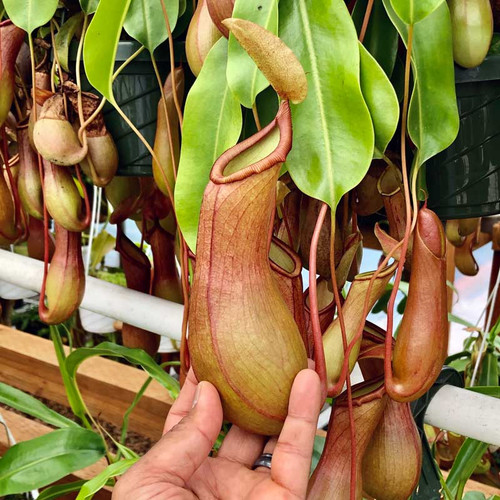
At our nursery, Nepenthes pitchers grown in summer are slightly smaller than pitchers grown in winter when the humidity is higher. In summer, when the exhaust fans kick in, the relative humidity in the greenhouse might be anywhere from 25 to 40%. In winter, when we seal up the intake and exhaust vents, humidity naturally rises to 85% and more. At higher humidity, we don’t see more pitchers on our plants. Instead, we see larger pitchers. But the difference in size is only about 25%. So, Nepenthes sanguinea might produce 6-inch pitchers in summer, and larger 8-inch pitchers in winter.
The smaller pitchers in summer is a natural response by Nepenthes to slow down moisture loss when relative humidity fluctuates a lot. In winter, when moisture loss is minimal because relative humidity is much more stable, they produce larger pitchers.
But, I want to make it very clear. Nepenthes will adapt to household humidity. While higher humidity can account for larger pitchers, when it comes to pitcher development – growing pitchers and all of their complex parts - sunlight and temperature are the driving forces. Without proper lighting and temperature, Nepenthes won’t produce pitchers, regardless of the humidity.
Now, besides improper lighting and temperatures, there are other factors that negatively affect pitcher growth, and I will cover them in a future video. For the purpose of this video, I wanted to address specifically the idea of humidity and pitcher growth within the context of a question I got from a grower. She asked if putting her Nepenthes sanguinea under a humidity dome was a good solution for pitcher growth. Her question didn’t have a simple yes or no answer because it was based on a faulty premise, mainly that high humidity is a huge factor for growing pitchers.
Based on what we know about plant physiology and seeing how plants adapt to fluctuating humidity, constant high humidity is not a driving force for pitcher development. So putting a Nepenthes under a humidity dome is superfluous at best. Nepenthes sanguinea has the ability to adapt to large fluctuations in relative humidity, and there are countless varieties of Nepenthes that also fall into this category.
Sunlight and temperature are by far the biggest factors that affect pitcher development. Nepenthes will acclimate to fluctuating humidity. However, they will not acclimate to improper lighting and temperature. So the grower should focus on providing her plant with more lighting to improve its color, vibrancy, and pitcher growth. She should also make sure her daytime temperature rises around 70° or more to maintain proper metabolism. At night, the plant will appreciate a moderate temperature drop, as low as 50°F.
I know this was a complex topic, and I encourage you to rewatch this video. Each section is timestamped, so you can jump to the parts that you want to watch again.
As mentioned earlier, besides improper lighting and temperatures, there are other factors that affect pitcher growth, and I plan to cover them in a future video, so make sure to subscribe for a notification when that video comes out.
I also tried to keep the science terminology in this video at a minimum. But, if you want me to produce another video where I unabashedly nerd out on the science of humidity and plant physiology, let me know in the comment section. I’d be glad to make it for you. In the meantime, if you want more info about growing Nepenthes, watch our Volume 3 video playlist. We also have a Nepenthes care sheet that you can download and print out. Visit growcarnivorousplants.com for these resources.
And while you’re on our website, check out the Nepenthes we have in stock. All plants are shipped potted and ready to go. Our inventory changes monthly and seasonally, so if you want notifications of inventory updates, sign up for our newsletter or subscribe to this channel. Thank you so much for watching. I look forward to seeing you in another video.
• The original question and response have been edited for publication.
• To submit a carnivorous plant question, visit Ask the Growers.