Q/A #156 - Revitalizing a Pitcherless Nepenthes
- January 11, 2025
TRANSCRIPT
Jacob here with Sarracenia Northwest. Since 2005, we’ve answered thousands of questions from carnivorous plant growers and have seen plants grown in many different situations. Here’s a question we got in January 2021.
“I finally succeeded in getting a Nepenthes cutting to root and grow after many tries… It has very small pitchers and is one of two in the pot. But sorry to say, recently one [of the pitchers] died. I have the plant in a south window in Wisconsin. I mist it every day. It is about 8 months old, and it still has very small pitchers. What can I do to make it more fruitful and happy?”
The grower also submitted a few photos of his plant. We can see that the plant is next to a window alongside some containers of water with duckweeds. The plant has only one pitcher, and it’s very small and poorly colored.
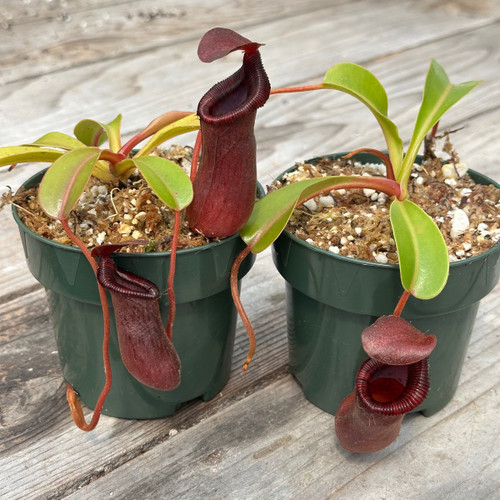
The grower didn’t know what type of Nepenthes this was, but based on the general shape of the pitcher and leaves, I suspect the plant is Nepenthes Deroose Alata. We’ve gotten lots of questions regarding this particular plant, so it’s easy for us to identify. It’s a very common houseplant that you can find at your local hardware store, next to the Venus flytaps.
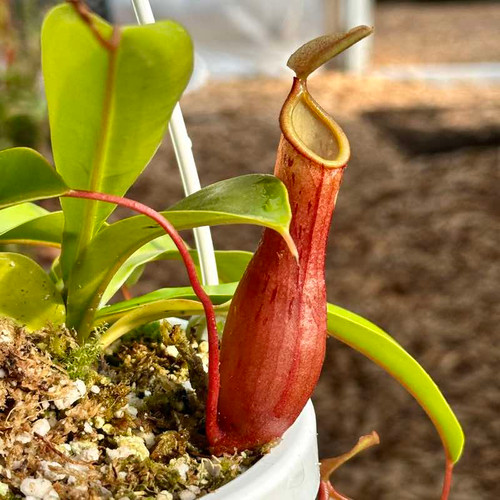
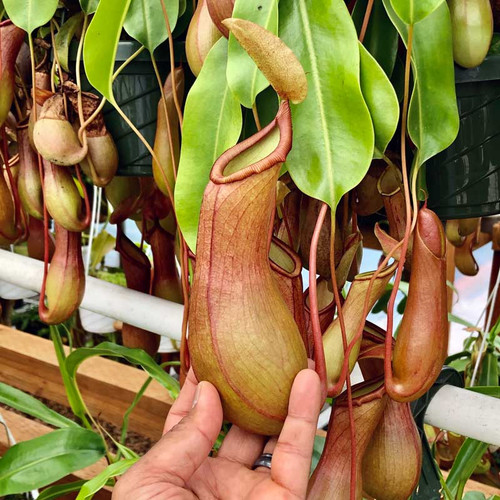
It’s marketed as Nepenthes Alata, but it’s not a true species. It’s actually a hybrid of alata and ventricosa. A true Nepenthes alata looks similar to the hybrid, so to differentiate the hybrid from a true Nepenthes alata, we call this plant Nepenthes DeRoose Alata. DeRoose is the name of the nursery in the Netherlands that mass-produced this plant. When properly grown, it produces lots of red pitchers. The leaves should also be bright green, almost lime green.
Based on what I see in the grower’s photos, his plant needs more sunlight. Lack of sunlight is the number one reason why Nepenthes don’t produce pitchers. And I know this surprises a lot of first-time growers. Nepenthes pitchers are very complex leaf structures with many parts, such as the lid, peristome, and wings. Pitchers also have to produce nectar to attract insects, fluids to drown insects, and enzymes to break them down. To create all of this requires a tremendous amount of energy, and plants need sunlight to manufacture sugars to convert into energy. Without enough sunlight, Nepenthes won’t produce pitchers.
Part of the problem for this grower is that it’s winter in Wisconsin. Even though he has the plant in a south window, the daylight hours and sunlight intensity in that window are not enough for his plant. He can supplement natural sunlight with LED lights, keeping the lights about 8-12 inches above the plant and using a timer for a14-hour daylight cycle.
In one of the photos, the grower has a thermometer and hygrometer. When the photo was taken, the temperature was 70°F and the relative humidity was 30%.
70 is the minimum daytime temperature for most Nepenthes. A plant’s metabolism is affected by temperature, so if the temperature isn’t warm enough, the plant won’t have enough energy to create pitchers. Ideally his day temperature should be in the upper 70s. But if 70 is the best he can do, then he just has to accept that his plant is going to grow slower in winter.
Finally, we come to misting. He said he was misting his plant daily. Misting is one of those old urban legends about houseplants. I know the goal of misting is to increase ambient humidity, but it doesn’t do that at all. When you mist a plant, water droplets evaporate and temporarily increase the humidity surrounding the plant. But, the localized humidity will dissipate within minutes, and you’re back to the same humidity level as before. If you want to increase ambient humidity, you need to mist the entire room, not just the plant. So, misting is often a waste of time. It makes growers feel good that they’re doing something, but it has no significant benefit to the plant.
In the grower’s photo, the relative humidity is 30%, which is normal in most homes during winter. So, based on this reading, misting hadn’t done anything to increase ambient humidity. And if misting had any benefit to the plant, the plant would have produced pitchers by now.
There’s also a myth that high humidity is essential for pitcher production. Nepenthes are tropical plants that can and will acclimate to lower humidity. There’s nothing inherent about the plant that requires it to be in constant high humidity, and many Nepenthes available commercially can be grown as houseplants. I’ve grown truncata, albomarginata, and Red Queen in my windows over the years.
We also have many customers who have successfully grown Nepenthes as regular houseplants. As long as the soil is healthy, the plants are watered regularly, and they’re getting lots of sunlight, most Nepenthes will produce pitchers, even in winter. Deroose Alata is no exception.
So, in this particular scenario, the grower needs to use supplemental lighting. In spring and summer when the weather is warmer and sunlight is more abundant, he’ll see more pitchers on his plant.
If you want to learn more about growing Nepenthes, visit our website, growcarnivorousplants.com. We have care sheets and videos, all designed to get you on the right track. Also check out our inventory of Nepenthes for sale. Our inventory changes monthly and seasonally, so make sure to sign up for our monthly newsletter online. Thank you so much for watching. I look forward to seeing you in another video.
• The original question and response have been edited for publication.
• Click on a hashtag below or use the site's search function to view similar topics.
• To submit a carnivorous plant question, visit Ask the Growers.


![Soil, Peat/Perlite Mix [Gallon Bag]](https://cdn11.bigcommerce.com/s-4kt71d4v98/images/stencil/500x500/products/120/2084/Soil-60__12201.1664306082.jpg?c=1 "Soil, Peat/Perlite Mix [Gallon Bag]")