How Much Perlite to Add to Peat Moss?
- September 25, 2022
How much perlite should we add to our carnivorous plant mix? While peat moss is the primary soil ingredient for carnivorous plants, namely Sarracenia, Venus flytraps, and sundews, we add perlite to improve drainage and aeration. Aeration is important to prevent pathogenic bacteria and stunted plant growth. Now, some sites say to use 10 to 30%, while folks like our nursery recommend 50%. And then there are some folks who don’t use perlite at all. They use straight peat moss. So, which is it? Well, let’s take a look.
I have in front of me, several mixes of peat moss and perlite, ranging from straight peat moss, to 10% perlite, 20, 30, 40, 50, and 60% perlite. With each mix, I’m going to pour two cups of water through the soil and time how long it takes for half of it, or 1 cup, to pass through. This will give us a good idea of both drainage and aeration.
Now, Sarracenia, flytraps, and sundews are bog plants, so it’s ok for them to sit in trays of water. In fact, that’s how we recommend watering them, from the tray. Water will wick up to the upper portions of the soil through capillary action. In this type of watering system, you might think that drainage isn’t that important, especially given how these plants grow in the wild.
But, keep in mind that in the wild, a bog is an open system and there is always some sort of water movement, which helps aerate the soil. In cultivation, plants are in a closed system with virtually no water movement. So, we have to rely on soil amendments, such as perlite, for aeration.
So, how much perlite should we use? And that’s a good question because if you don’t use enough, you won’t have adequate aeration. If you use too much, you lose the wicking action of peat moss. So, it’s a matter of finding that right balance that has the best of both worlds.
We will figure this out by timing the flow rate of water through the different soil mixes. Drainage is a good way to assess soil aeration. As water flows through the soil, it creates negative pressure on the top of the soil that pulls air into the soil. Sort of like a vacuum effect. So, the quicker the water flows through the soil, the more air it pulls through. The slower water flows, the less air it pulls.
Now, when we’re bottom watering, the vacuum effect isn’t there. But, we can use flow speed to assess how well the soil can breathe on its own. And that’s a very important concept. How well soil can breathe on its own to prevent anaerobic bacteria when we’re only watering from the bottom.
To prepare the soil, I hydrated the peat moss and perlite separately before mixing them. That way, all ingredients in each mix would be equally hydrated. The only difference would be the proportions. When I filled the pots, I filled them only to the ridge line and tapped them firmly on the table several times to get rid of large air pockets. Here’s the time for peat moss in a 6-inch pot, no perlite. And here are the results for the other percentages.
This is a graph of the results. The higher the bar, the longer it took for water to flow through. Now, immediately, something appears to be off. Intuitively, you might expect the flow time to be highest with peat moss by itself and gradually decrease as we add perlite. Instead, we see the flow time increase at 10% perlite. At 20%, the flow time is nearly identical to 0% perlite. We then see the time drop significantly with 30%. The flow time remains essentially the same with 40% and 50% perlite. At 60%, water flows through the quickest.
I decided to run the experiment again because I wanted to see how each soil would perform after it settled a bit more. Here are the results. We see a massive spike with 10% and 20%. 30% is roughly the same as 0%. 40 and 50% are essentially the same with each other but lower than 30%. And 60% is again the quickest. Now, when you compare the results of the two trials side-by-side, you’ll see an overall increase in time across the board. I’m assuming it was because the soil settled and was a bit firmer after the water passed through it the first time.
Now, you might be curious about the mixes with 10% and 20% perlite. You would expect them to be faster draining than peat moss by itself. But that wasn’t the case here. In fact, that wasn’t the case in the previous two times we ran the experiment. What I showed you were the 3rd and 4th times we did the experiment because we couldn’t make sense of what we saw the first two times. The first time we ran it, we used a clear plastic cup with the bottom cut off as our pot. We then placed the cup over a sieve and poured water over it. Here are the results of that first experiment. 20% and 30% took a long time to flow through compared to straight peat. 40 and 50% had quicker flow rates.
We were scratching our heads over those results because we expected peat moss to have the highest drain time. We thought that maybe the cup wasn’t the right tool for the experiment. So, we went with a 4-inch pot again over the sieve, just like this. Here are the results. Again, we were scratching our heads. Why does 20% have a longer drain time than 0%? Now, we assumed the sieve was the reason for these weird results. Maybe the holes got blocked with peat moss. That’s when we decided to use a 6-inch pot that would fit snugly over a measuring cup. So, those trials with the 6-inch pot were actually the 3rd and 4th times running the experiment.
Now, was really curious about what was going on, so I did the experiment for a 5th time. But, I wanted to redo the 4-inch pot. This time using a strainer, like this, to hold it over the measuring cup. Here are the results. The results seem to be consistent with 10 and 20% perite. 30% also didn’t perform very well in the 4-inch pot. Flow rate improved with 40% but was still more than 0%. 50% was identical to 0%. And, of course, 60% was the clear winner regarding flow time.
Now, regardless of the setup, mixes with 10 and 20% perlite had drain times that were no better than using no perlite, 0%. I meant, seriously, what was up with that? It took me a while to figure this one out, but here’s my theory. It has to do with water tension.
Water likes to cling to the tiny, fine particles in peat moss. It also wants to adhere to all the nooks and crannies found in perlite. By adding perlite at only 10 or 20%, you increase the surface area for water to cling to, but you don’t have enough perlite to create a channel for water to flow. The perlite is still surrounded by peat moss.
When gardening, if your yard has lots of clay, you can work gravel into the soil. But, if you don’t use enough gravel, you end up with something almost akin to concrete because water tension increases. You need to have enough gravel touching each other to overcome that water tension. The same is true with peat moss and perlite. You need enough perlite touching each other to overcome that increase in water tension and provide a channel for water to flow through. At 10 and 20%, we’re not seeing that happen at all.
So, what can we conclude from these results? First, let’s go back to the original question. How much perlite do we really need for adequate aeration, especially when watering from the tray. Remember, we’re looking for a soil mix that can breathe well on its own. Based on the totality of the results, 10 and 20% had the slowest drain times, so we recommend avoiding those percentages. A mix with 30% perlite was inconsistent, so we’re on the fence with that one. 40% had good drainage on most of the trials. Even when you visually inspect the soil, you can see that 40% has more perlite particles touching each other than 10, 20, and 30%. When perlite particles are touching, you have a channel to aerate the soil. Again, 30% is on the fence with that. But, you can see it a bit more at 40%. The same is true for 50%. 60% is the clear winner here.
We didn’t think about including 60% in the initial two trials until I remembered that we used to use it about a decade ago. Mainly, I was looking for ways to decrease our shipping weight. But after a couple of years, we went back to 50% because we didn’t see a decrease in our shipping costs. We still use 60% on occasion, and I’ll talk about that later.
Now what about just using straight peat moss? Granted, in the wild, peat bogs don’t have perlite. But, keep in mind, there is always some kind of water movement through a bog, and the surface area is enormous when you compare it to the surface area of a potted plant. On top of that over time, peat moss will compress in the pot, decreasing flow rate. When that happens, you risk an overgrowth of anaerobic bacteria that can stunt your plant’s growth. Well aerated soil will have a clean, fresh, earthy scent. Poorly aerated soil will sometimes have a funky odor to it, almost like rotten eggs. If your soil smells like that, it’s time to change the soil.
So, based on what we’ve seen, we recommend using a mix with at least 40% perlite. This seems to be where we see more consistency with drainage. We prefer 50% perlite because, well, frankly, it’s a lot easier to portion out. We also based it on a similar mix that Adrian Slack recommended in his book, Insect-Eating Plants, first published in 1986. Now, the book is out of print, but Adrian Slack is one of the pioneers of carnivorous plant cultivation
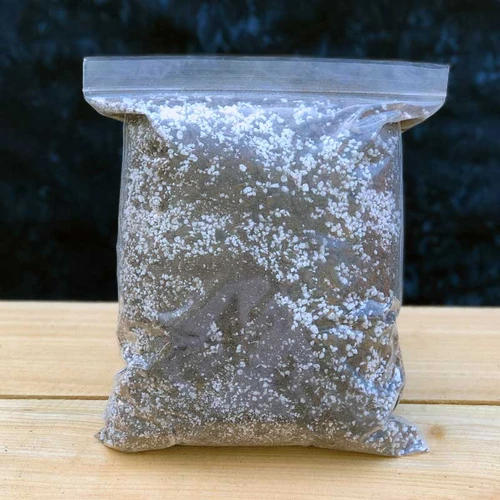
In these experiments, we used a medium grade of perlite. On occasion we will use a fine grade. This grade also works well with 4-inch pots and smaller. But, we increase the proportion to 60% to provide more structure to the soil. To achieve 40%, use 3 parts peat moss and 2 parts perlite. For 50%, use equal parts of each. For 60%, use 2 parts peat moss and 3 parts perlite. Now, we don’t recommend using more than 60% because you may lose the wicking action of the peat, especially in large pots.
We’ve been using a mix of 50% perlite since we started the nursery in 1995, and we’ve found that it resists compaction and has lots of channels to aerate the soil. And because we keep the water level below the halfway point of the pot, we haven’t had any issues of anaerobic bacteria, or crown rot. In short, this is a percentage that allows the soil to breathe well on its own when you’re watering from the tray.
The mix also performs well in a variety of growing conditions and climates. It doesn’t matter if you’re growing in a greenhouse or outdoors, or using a 4-inch pot or a bathtub, or if you’re in Arizona, Florida, or Oregon for that matter. 50% perlite will help keep your soil healthier longer, sometimes 8 years or more. We have a large pot of flytraps that have been in the same soil for the past 8 years.
Now, if you prefer to top water your plants, check out our video about top dressing to prevent soil erosion. If you need soil for your carnivorous plants, like, Sarracenia, Venus flytraps, and sundews, visit our website at growcarnivorousplants.com. Thank you so much for watching, and I look forward to seeing you in another video.
• The original question and response have been edited for publication.
• To submit a carnivorous plant question, visit Ask the Growers


![Soil, Peat/Perlite Mix [Gallon Bag]](https://cdn11.bigcommerce.com/s-4kt71d4v98/images/stencil/500x500/products/120/2084/Soil-60__12201.1664306082.jpg?c=1 "Soil, Peat/Perlite Mix [Gallon Bag]")