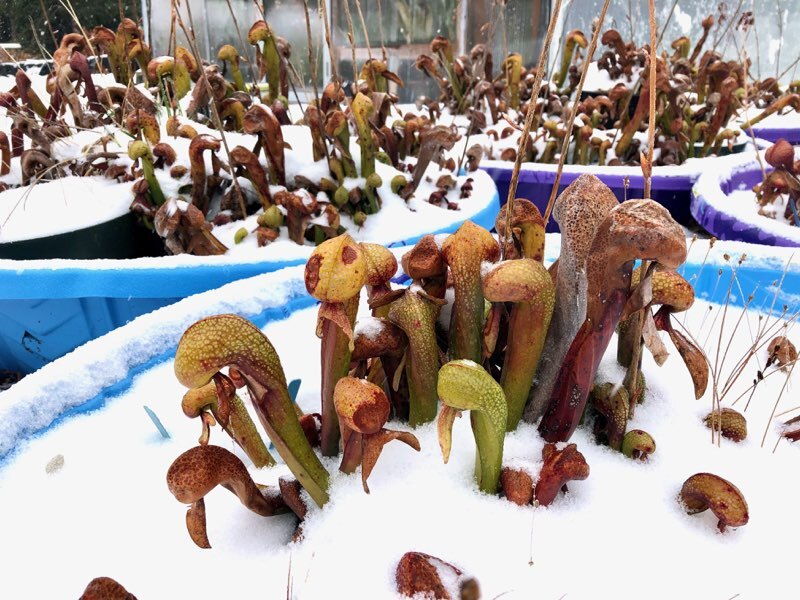
What Kind of Water Does Darlingtonia Need?
Keep the growing medium consistently wet during the growing season.
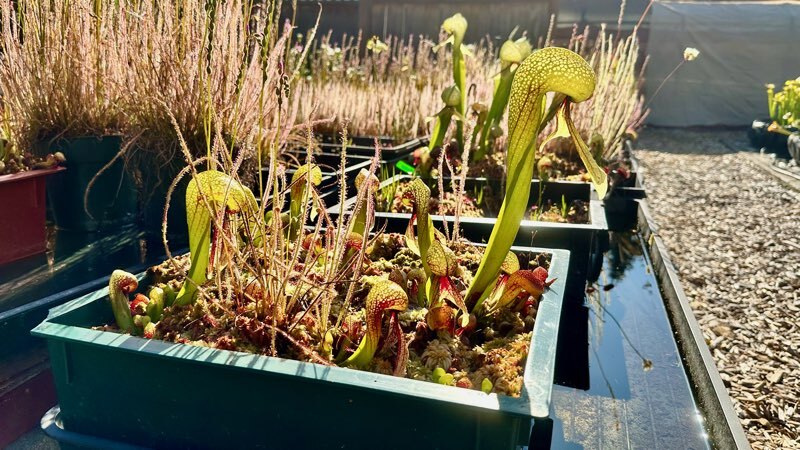
We recommend setting the pot in a shallow tray of water, keeping the water level below approximately the halfway point of the container.
Darlingtonia grown in a granular mineral mix can tolerate somewhat more dissolved minerals than many other carnivorous plants.
However, because you may also be growing Sarracenia, Venus flytraps, sundews, or live sphagnum moss,
we recommend simply using the same low-mineral water under 50 ppm that you use for your other carnivorous plants.
Low-mineral water is particularly important if you choose to grow Darlingtonia in live sphagnum moss (see below).
Periodically Flush the Water Tray
Every few weeks during the growing season, completely empty the water tray rather than continually adding fresh water to the old water.
Then top-water the pot thoroughly and allow the drainage to refill the tray. This helps flush away accumulated contaminants and reduces the opportunity for fungal pathogens to spread through standing water.
What Is the Best Soil for Darlingtonia?
Darlingtonia is particularly susceptible to fungal root rot in cultivation.
For this plant, we focus less on keeping the soil cold and more on maintaining a healthy root environment.
After experimenting with numerous growing media over many years,
we currently recommend either live sphagnum moss or an inorganic granular mix.
Option 1: Live Sphagnum Moss
Live sphagnum closely resembles the growing conditions found in many Darlingtonia habitats along the Oregon Coast.
Living sphagnum holds large amounts of water while maintaining excellent aeration around the roots.
It also creates conditions that can help suppress fungal growth.
In our experience, Darlingtonia growing in live sphagnum also produces abundant underground runners, called stolons.
The primary disadvantage is maintenance. Live sphagnum grows slowly and must remain continuously wet.
During hot weather, frequent top watering may be necessary to prevent the moss from drying out. If the moss dries out, it loses its
fungal-suppressive properties.
Option 2: Granular Mineral Mix
Our other recommended medium is granular mineral mix based on experiments designed to mimic the mineral-rich soils associated with
Darlingtonia populations in the Siskiyou Mountains. The mix contains no peat or other decomposing organic potting material.
It has produced particularly consistent results for us when reducing fungal problems and salvaging plants affected by root rot.
Our current nursery recipe is:
1 part vermiculite
1 part perlite
1 part Turface®
You can also use 1 part vermiculite and 2 parts pumice,
or another suitable combination using 1 part vermiculite and 2 parts inert drainage material.
For a more detailed explanation of the mix and why we use it, watch our video, New 2026 Darlingtonia Guidelines.
Key Concept
The general principle of the granular mix is to provide a sterile and well-aerated environment for Darlingtonia's roots.
Vermiculite alone will do that, but we include other ingredients for additional drainage and aeration.
The drainage material simply needs to be inert. Pumice works just as well as perlite and Turface.
As long as you think in terms of "inert drainage material", you can create a granular mix with what you have available.
Can I Combine Live Sphagnum With the Granular Mix?
We don't recommend it. Vermiculite is not compatible with maintaining healthy live sphagnum over the long term.
Vermiculite is also not part of our recommended growing media for Sarracenia, Venus flytraps, or hardy sundews. If you're using the granular Darlingtonia mix, keep those pots in a separate water tray from your other outdoor carnivorous plants.