Troubleshooting a Struggling Sundew
- November 16, 2024
VIDEO TRANSCRIPT
Jacob here with Sarracenia Northwest. Since 2005, we’ve answered thousands of questions from carnivorous plant growers. We recently got a question in October about a tropical sundew.
“I have a white-leaf Drosera capensis. I’m growing in a window and giving it partial sunlight. The plant is in its original soil when I purchased it six months ago, and I water with soft water. I’m simply wondering how to winter my plant. Do I keep watering it, or do I let it go dry? Should I be concerned if it looks like it’s failing?”
From his photo, something serious is happening with his plant, which has nothing to do with winter. Drosera capensis is a tropical plant, so its care is the same in winter as it is in summer. Initially, I thought his plant was suffering from low light because it has some classic signs of poor lighting - lack of dew and leaves flopping over. We often see these symptoms when this species is grown in poor lighting.
But the brown tips aren’t associated with low light. It’s most related to harsh sunlight. Hot temperatures can also cause dewless leaves, and we sometimes see this happen in our plants during the summer. So, his window might be too hot for that plant, but something else stood out to me.
The grower mentioned that he was using soft water. Soft water and hard water are generic terms we use to describe the mineral content of water. Soft water has a low mineral content, and hard water has a high mineral content. However, soft water is more often used as a term for water that passes through a water softener. Water softeners work by replacing calcium, magnesium, and iron with sodium chloride or table salt. The water is called soft because it doesn’t have calcium and other minerals, even though it has sodium. But, the point is, that’s how the term soft water is often used – water filtered by a water softener.
Sodium in water is just as bad for carnivorous plants of all types. Sodium is a mineral, and it’s best to avoid it when watering your carnivorous plants. With that said, the grower didn’t specifically say he was using a water softener. He just said he waters with soft water, so I asked him about it, and he confirmed it. He said, “Originally, yes. My water originated from a soft water filtration system. As of late, I have switched to simply filtered water, but I do not believe that will work either… I also must mention that most water around here runs 140-350 ppm in mineral content.” So, this confirmed my suspicions about his water.
When it comes to carnivorous plants, water should have mineral levels lower than 50 ppm. Even with a water softener, his mineral levels are still too high because the calcium was just replaced with sodium. He mentioned that he recently switched to filtered water but didn’t mention what type of water filter he has. Typically, when growers tell me they’re using filtered water, 9 times out of 10, they’re using a carbon filter, like Brita or Pur. These filters are excellent in removing sediment and organic material, but they are ineffective in removing calcium or iron. The only types of water filters that effectively remove minerals are distillers, deionizers, and reverse osmosis. So, when growers just say they’re using filtered water, I assume they are using a carbon filter unless they tell me otherwise.
So, the brown tips on this grower’s sundew occurred because minerals were transported from the soil to the leaves, where they were deposited at the tips. Over time, the tips started dying off. When I zoomed in on one of the photos, I could also see the tip of the new growth turning black. These symptoms are associated with mineral accumulation.
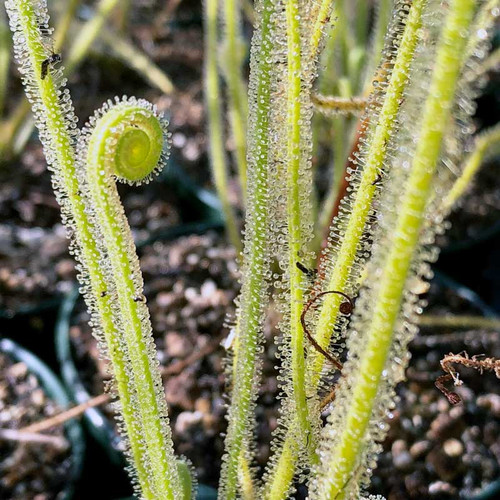
In a previous video, I talked about how poor lighting can cause sundews to be dewless. Mineral accumulation can do the same. Sundews have tiny hairs on their leaves. These hairs are called trichomes, and on the tip of each trichome are glands that secrete nectar to attract insects. As excess minerals are transported throughout the plant, some will be deposited on the trichomes and essentially clog up the gland, preventing it from producing nectar.
I also mentioned earlier that hot temperatures can cause these same symptoms, so the window could still be too hot for that plant. But, this type of sundew, the Drosera capensis, usually produces shorter leaves if the temperature and sunlight are too harsh.
I have the same variety of sundew here, the alba or white-leaf form of Drosera capensis. In the typical form of capensis, the trichomes are red. On the alba, the trichomes are white. But it’s not a true alba because the plant still has red pigments. The trichomes turn pink when grown in very bright lights, and the leaves will also shorten, as you can see here. We grow our mother plants in practically full sun because it shares the same bench as Drosera multfida, which requires full sun. In moderate lighting, however, the trichomes will be white, and the leaves will be slightly longer.
In the grower’s photos, the leaves on his plant are the appropriate color and length, so that window seems appropriate. I don’t see any indication that the sunlight is too harsh or the temperature is too hot. So, everything about his plant strongly pointed to water with a high mineral level as the culprit.
I told the grower that he need a different water source that has very low mineral levels. Since he had only one plant, he could use bottled distilled water or rainwater. He could also get a deionized water filter, such as ZeroWater. He should also change his soil with fresh peat moss and perlite. Until he could do that, I recommended that he flush the soil with distilled water to remove the mineral buildup. He’ll need at least a gallon of distilled water to do that. After making the appropriate changes, his plant will likely recover within 2-3 months.
If you want to learn more about growing tropical sundews, watch our Volume 2 playlist. You can find the playlist on our website, growcarnivorousplants.com. While you’re on our website, check out inventory of tropical plants. Our inventory changes monthly and seasonally, so also make sure to subscribe to our monthly newsletter for inventory updates. Thank you so much for watching. I look forward to seeing you in another video.
• The original question and response have been edited for publication.
• Click on a hashtag below or use the site's search function to view similar topics.
• To submit a carnivorous plant question, visit Ask the Growers.


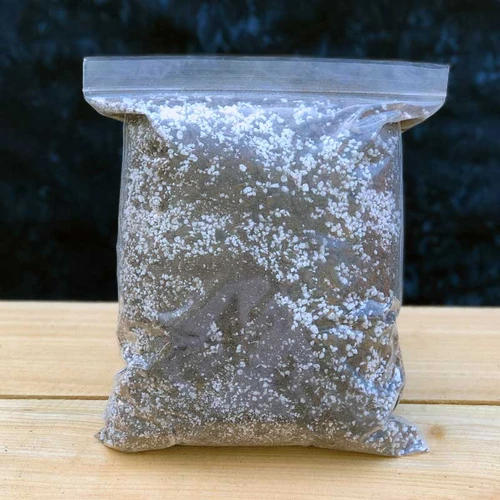
![Soil, Peat/Perlite Mix [Gallon Bag]](https://cdn11.bigcommerce.com/s-4kt71d4v98/images/stencil/500x500/products/120/2084/Soil-60__12201.1664306082.jpg?c=1 "Soil, Peat/Perlite Mix [Gallon Bag]")


![Soil, Tropical Pitcher Plant Mix [Gallon Bag]](https://cdn11.bigcommerce.com/s-4kt71d4v98/images/stencil/500x500/products/121/3209/Soil-2__11156.1776819725.jpg?c=1 "Soil, Tropical Pitcher Plant Mix [Gallon Bag]")