A Common Cause of Unhappy Sundews
- November 9, 2024
VIDEO TRANSCRIPT
Jacob here with Sarracenia Northwest. We've answered thousands of questions from carnivorous plant growers over the years, and this question I pulled from the archives from March 2023.
“I received a Drosera multifida a month ago. It looks like it's dying and burnt. The other sundew and butterwort are doing good. They are all next to each other getting fluorescent lights in a kitchen and a grow light. I fill the bottom of the container with distilled water. What's going on with the Drosera multifida?”
She sent us a couple of photos. The first photo shows a Drosera multifida with several leaves that died off. The single remaining leaf is hanging in there. When I zoom in on the photo, I can see that there isn't any dew on that leaf. The second photo shows the entire group of plants. There's a Drosera capensis on the left, a Pinguicula Aphrodite in the middle, and a Drosera multifida on the right.
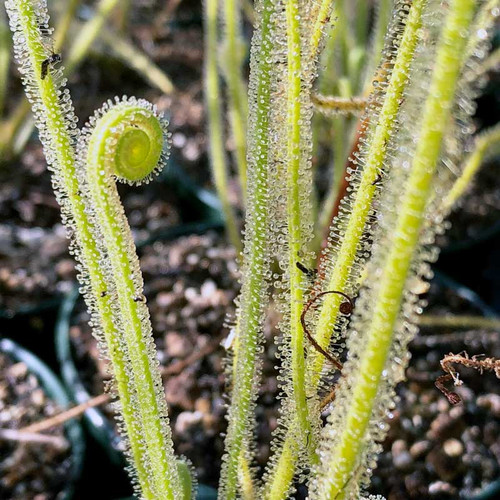
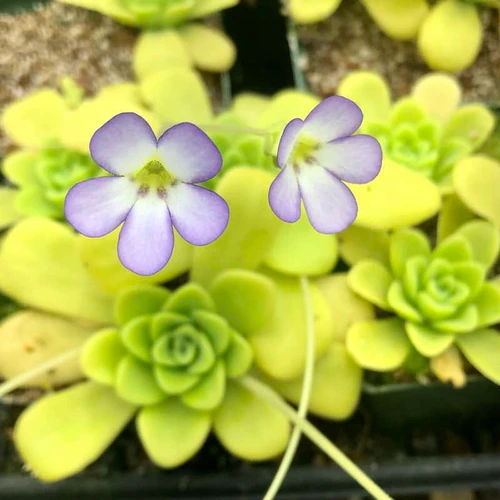
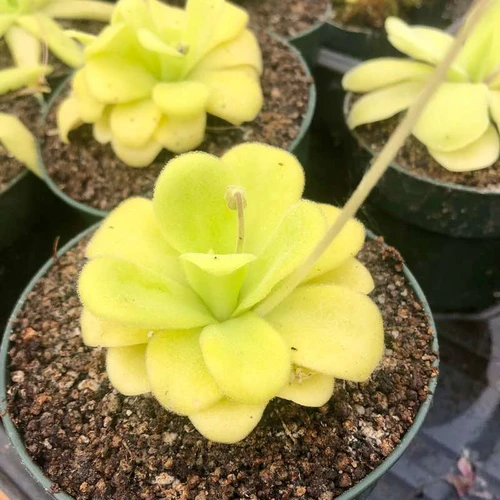
I have those same plants here with me – Drosera capensis, Pinguicula Aphrodite, and Drosera multifida. The smaller plants are what we typically ship out. The larger plants are mother plants that we use for propagation. This how they look like when grown in optimal conditions.
Now, I'm glad she sent a photo of her collection because it helped me figure out what was happening. Simply, her multifida is suffering from poor lighting. In fact, all of her plants are showing signs of not getting enough light. Even though she's using grow lights, her lights are not strong enough to keep them happy. And what I like about the photo is that it shows how different plants respond to low light conditions.
The Aphrodite looks relatively decent. This plant will grow ok in somewhat low light conditions. But there is a trade-off. Ideally, the plant has lovely pink leaves when grown in optimal lighting. When I look closely at her butterwort, I can see that the new growth in the center is green. The plant will grow ok under her lights, not great, just ok, and the pink hue will eventually fade to green.
The capensis looks ok, but it's actually not doing that great. The variety of capensis the grower has is called Big Pink. The plant should have dark pink leaves. The leaves should also be dewy and standing straight up. The leaves on her plant are curling downwards and lack dew. The new growth coming up in the center of the plant is green. These symptoms – the leaf curling downwards, lack of dew, and lack of red pigment on the new growth – are associated with poor lighting.
The multifida is suffering the most. Of the three plants, this one requires the most sunlight, full to partial sunlight. As the plant matures, the end of each leaf will branch out into multiple forks, giving its name multifida. Over time, the red leaves will elongate and fall over from being top heavy, and this is a normal characteristic for this plant. If the lighting is too low, the leaves will shrivel up, as we can see in the photo. The one remaining leaf is also dewless and dry.
So, this grower isn't alone in her mistakes. It's common for first-time growers to underestimate how much light these plants need. Sundews need energy to create the dewy secretion, and they get their energy from sugars they produce through photosynthesis. If there isn't enough photosynthesis, sundews will stop making dew, and you will end up with dry leaves. Based on all the questions we've gotten over the years, poor lighting is the number one reason for dewless leaves. And if the lighting bad enough, the plant will drop its leaves.
Another common mistake first-time growers make is using a plant of one variety to determine if lighting is adequate for another. The grower remarked, "The other sundew and butterwort are doing good." You can't use one species' growth habits to determine if whether your growing conditions are adequate for other species. You have to follow what the plants are telling you.
Her butterwort looks good because, of these three plants, it has the lowest minimum light requirement. Just a few hours of direct sunlight will keep this plant happy. While the grower thinks her Drosera capensis looks good, it actually doesn't, not when you compare it to our standards. Its leaves should be standing up straight. They should also be dewy and pink. This plant needs partial sunlight, 4-6 hours of direct sunlight. While her plant doesn't look as bad as the multifida now, it's just a matter of time. Of course, the Drosera multifida looks the worst because it requires the most sunlight, practically full sun. It is NOT tolerant to low light conditions.
On top of that, she's using those purple LED lights. I'm not a fan of them, and not all plants grew well in our experiments with those lights. Some plants liked it, others did not. I told her she should switch to cool white LED shop lights. We had the most consistent results with these lights compared to those full-spectrum grow lights. I also told that her to place the fixture closer to the plants.
Since LED lights will be her primary light source, she should start 12-18 inches above the plants and adjust the height depending on how her plants grow over the next several weeks. Her Drosera multifida can be salvaged. Under optimal lighting, she will see healthy leaves within 4-8 weeks. Her capensis will also bounce back. It might take only 2-4 weeks to look normal again. And, of course, her Aphrodite will have those beautiful pink leaves again in stronger lighting.
If you want to learn more about growing sundews and butterworts, watch our Volume 2 playlist. You can find the link to the playlist in the description below, or visit our website, growcarnivorousplants.com, and look for the video playlist link. While you're on our website, check out our inventory of tropical carnivorous plants. Our inventory changes monthly and seasonally, so make sure to also subscribe to our monthly newsletter for inventory updates. Thank you so much for watching. I look forward to seeing you in another video.
• The original question and response have been edited for publication.
• Click on a hashtag below or use the site's search function to view similar topics.
• To submit a carnivorous plant question, visit Ask the Growers.


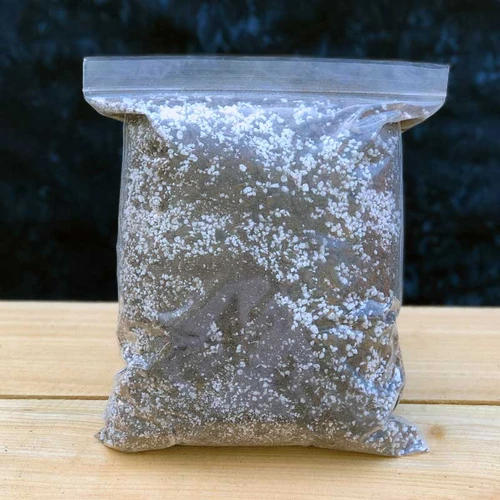
![Soil, Peat/Perlite Mix [Gallon Bag]](https://cdn11.bigcommerce.com/s-4kt71d4v98/images/stencil/500x500/products/120/2084/Soil-60__12201.1664306082.jpg?c=1 "Soil, Peat/Perlite Mix [Gallon Bag]")


![Soil, Tropical Pitcher Plant Mix [Gallon Bag]](https://cdn11.bigcommerce.com/s-4kt71d4v98/images/stencil/500x500/products/121/3209/Soil-2__11156.1776819725.jpg?c=1 "Soil, Tropical Pitcher Plant Mix [Gallon Bag]")