A Common Cause of Floppy Sarracenia Pitchers
- October 18, 2024
Hi, I’m Jacob, one of the growers here at Sarracenia Northwest. We recently got a question from a grower in the United Kingdom.
“I have a Sarracenia Juthatip Soper growing in a pot with other Sarracenia. The plants are outdoors in full sun. I would like to see my tall plant looking proud, but it just flops over. What can I do to make it stand up without staking it? It and all its companion plants are very healthy and vigorous in all other ways. They were potted in March this year.”
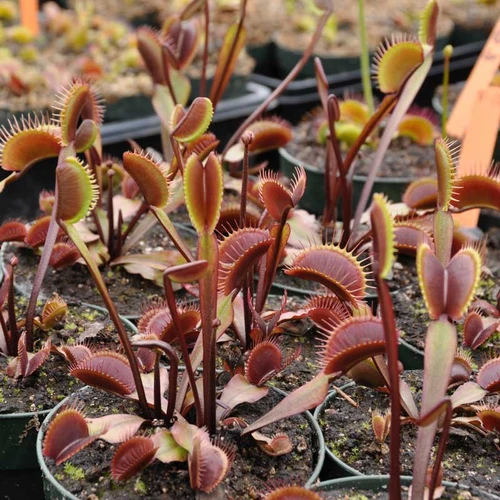
The grower sent a couple of photos of his collection. In the photos, you can see a tall Sarracenia flopping over in the back of the pot.
That plant is Sarracenia Juthatip Soper. Juthatip Soper is a cultivar developed by Matt Soper, owner of Hampshire Carnivorous Plants in Southampton in the UK. He developed this hybrid in the 1990s, so it’s been around in cultivation for a while. It’s a late-season Sarracenia, which means it produces its most stunning pitchers in late summer and early fall. The fall pitchers are sturdy and stout, and feature vibrant colors of pink and magenta.
It’s normal for pitchers from early season to flop over towards the end of the growing season, as we are now. There’s nothing wrong with them. That’s just the normal cycle for these pitchers. I often tell growers that if they’re bothered by them, they can just trim them off, especially if they’re turning brown. Trimming off the early season pitchers will bring more attention to the late season pitchers. But, the late season pitchers should be standing up straight like you see here. If they were flopping over, then we know something is wrong.
The most common reason why they flop over is poor lighting. Based on the grower’s photos, the plants are getting full sun. His Sarracenia purpurea has lots of red, and his leucophylla hyrids have lots of white in the upper portions of the pitcher, and these are indications that his plants are getting sufficient sunlight. His Juthatip Soper also looks appropriately colored, but the new pitchers are flopping over, even though the plant is in full sun.
But the reason why they’re flopping over is because the display is overcrowded. The new growth isn't getting sufficient sunlight and is being shaded by the other plants. When this happens, the new growth starts off weak and lanky. It doesn't experience full sun until it grows above the other plants. Growing in the shade initially means the base of the pitcher isn't strong enough to support the entire pitcher when it matures.
Now it’s perfectly fine to pot up different types of Sarracenia, but you have to space them appropriately so that the new growth also gets full sun.Earlier this year, I created a bathtub bog garden, and you can see how far apart I spaced the plants. I gave the plants lots of room to grow over the next five years. Even with the previous bathtub, I spaced the Sarracenia so that new growth on the tall plants also gets lots of sunlight.
So I suggested that the grower redo his pots in spring and space his plants further apart or regroup them. He can do them now, but we’re coming to the end of the growing season, and the plants are going dormant. During dormancy, sunlight isn’t as important as it is during the growing season, so he might as well let them overwinter clustered together until spring.
If you’re in the UK, make sure to visit Matt Soper’s website. He has a fine collection of Sarracenia and other carnivorous plants. You can find the link to his site in the description below. And if you need more information about growing Sarracenia and other carnivorous plants, visit our website, growcarnivorousplants.com. And if you’re located in the United States, check out the inventory we have on carnivorous plants. Our inventory changes monthly and seasonally. Thank you so much for watching. I look forward to seeing you in another video.
• The original question and response have been edited for publication.
• Click on a hashtag below or use the site's search function to view similar topics.
• To submit a carnivorous plant question, visit Ask the Growers.


![Soil, Peat/Perlite Mix [Gallon Bag]](https://cdn11.bigcommerce.com/s-4kt71d4v98/images/stencil/500x500/products/120/2084/Soil-60__12201.1664306082.jpg?c=1 "Soil, Peat/Perlite Mix [Gallon Bag]")


![Soil, Tropical Pitcher Plant Mix [Gallon Bag]](https://cdn11.bigcommerce.com/s-4kt71d4v98/images/stencil/500x500/products/121/3209/Soil-2__11156.1776819725.jpg?c=1 "Soil, Tropical Pitcher Plant Mix [Gallon Bag]")