


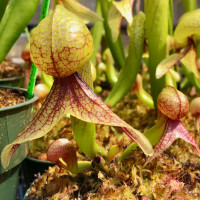
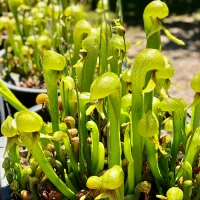
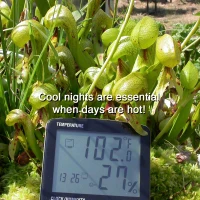


Darlingtonia is a plant that has perplexed many growers, including us! We've tried many growing methods to find one that works in different conditions. We've experienced many losses. We’ve shed buckets of tears. We’ve shouted many bad words. The one thing that will reliably boost your chances of success is living in a climate where summer nights fall below 60°F (16°C). Other factors like growing medium, sunlight, watering methods, daytime temperature, and plain luck are also important. But having consistently cool nights is a common factor among all successful growers, no matter the daytime temperature.
GENERAL CARE
Type of Plant: Hardy perennial for outdoor container growing.
Sunlight: Partial to full sun, 4+ hours of direct sunlight, during the growing season.
Water: Low-mineral water (50 ppm or less). Keep media wet.
Soil: Live sphagnum moss. No peat moss, garden soil, compost, or fertilizer.
Winter: Dormant. Mulch in USDA zones 6 or colder.
PLANT YOU RECEIVE
• Young offshoot from select mother plants.
• Acclimated for outdoor growing.
• Shipped potted, 3.5-inch pot, with live sphagnum moss. (Fourth and fifth photos are descriptive of the current batch with winter leaves.)
• 30-Day Health Guarantee
SEASONAL APPEARANCE
January-March: Plant is dormant. Pitchers will have brown spots. Dried pitchers are cut off.
April: Pitchers from last season will have brown spots. New pitchers will begin to appear by the end of the month.
May: Fully developed pitchers typically appear by the end of the month. Pitchers from last season may still be present.
June-August: Full display of pitchers.
September: Plant is slowing down. Some brown spots occur.
October: Dormancy begins. No new growth until spring. Some brown spots occur.
November-December: Plant is dormant. Pitchers will have brown spots. Dried pitchers are cut off.

