
Cold-Hardy Sundew Care
Get the straight facts from the guys who have grown and propagated thousands of carnivorous plants every year since 1995.
Where to Grow
Cold hardy sundews grow best outdoors as a container or potted plant on a sunny deck or patio. You may also grow them in a pond or fountain, but keep the crown of the plants above water. Because of their specific soil requirements, avoid planting them directly into the ground.
Sunlight
During the growing season, grow cold-hardy sundews outside in partial to full sun. Provide 4 or more hours of direct sunlight for vigorous growth.
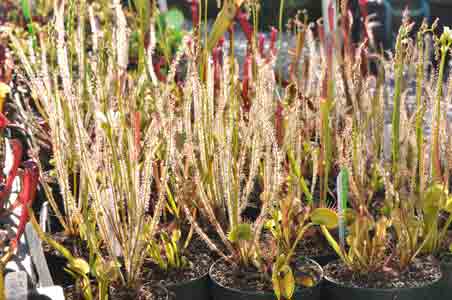
they can grow together in the same pot.
Heat Tolerance
Most cold hardy sundews, such as
Drosera filiformis, Drosera intermedia, and Drosera trayci, tolerate the summer heat well. They originate from an area where temperatures above 90°F (32°C) commonly occur in summer. Other sundews, such as Drosera rotundifolia, prefer mild temperatures.
Water
Sundews require mineral-free water. If your tap water is relatively pure (less than 50 parts per million in dissolved minerals), then you can safely water your sundews with it. Otherwise, use bottled distilled water. Keep the soil wet at all times. You can do this by setting the plant in small amounts of standing water, no more than halfway up the pot.
Soil
Use a soil mixture of 1 part peat moss and 1 part perlite. Never use potting soil, compost or fertilizer; these ingredients will kill your plant.
Winter Care
Your sundew will stop growing in late summer, and its leaves will gradually turn black. These are signs that your plant will soon be dormant, a similar process when a rose bush goes dormant and drops its leaves in fall. Eventually, it will form a small resting bud, called a hibernaculum, resting on the soil surface. While dormant, your sundew can withstand episodes of overnight frosts down to 20°F. If daytime temperatures are projected to rise above freezing, you don't need to protect it from these overnight frosts. However, protection is required during prolonged freezes to prevent dehydration or freeze drying, regardless of USDA zone. Covering your plant with a tarp or black plastic sheet will be sufficient if the freeze is expected to last for a week or less, which is typical for USDA zones 7 and 8. Otherwise, mulch may be required if you live in a region where freezing temperature is a way of life, such as in USDA zones 6 and colder.
CLICK HERE to download a PDF of this page.
Ready to grow a hardy sundew?
• Shipped potted with a 30-Day Guarantee.
• Available March through September.
• Click here
for current inventory.